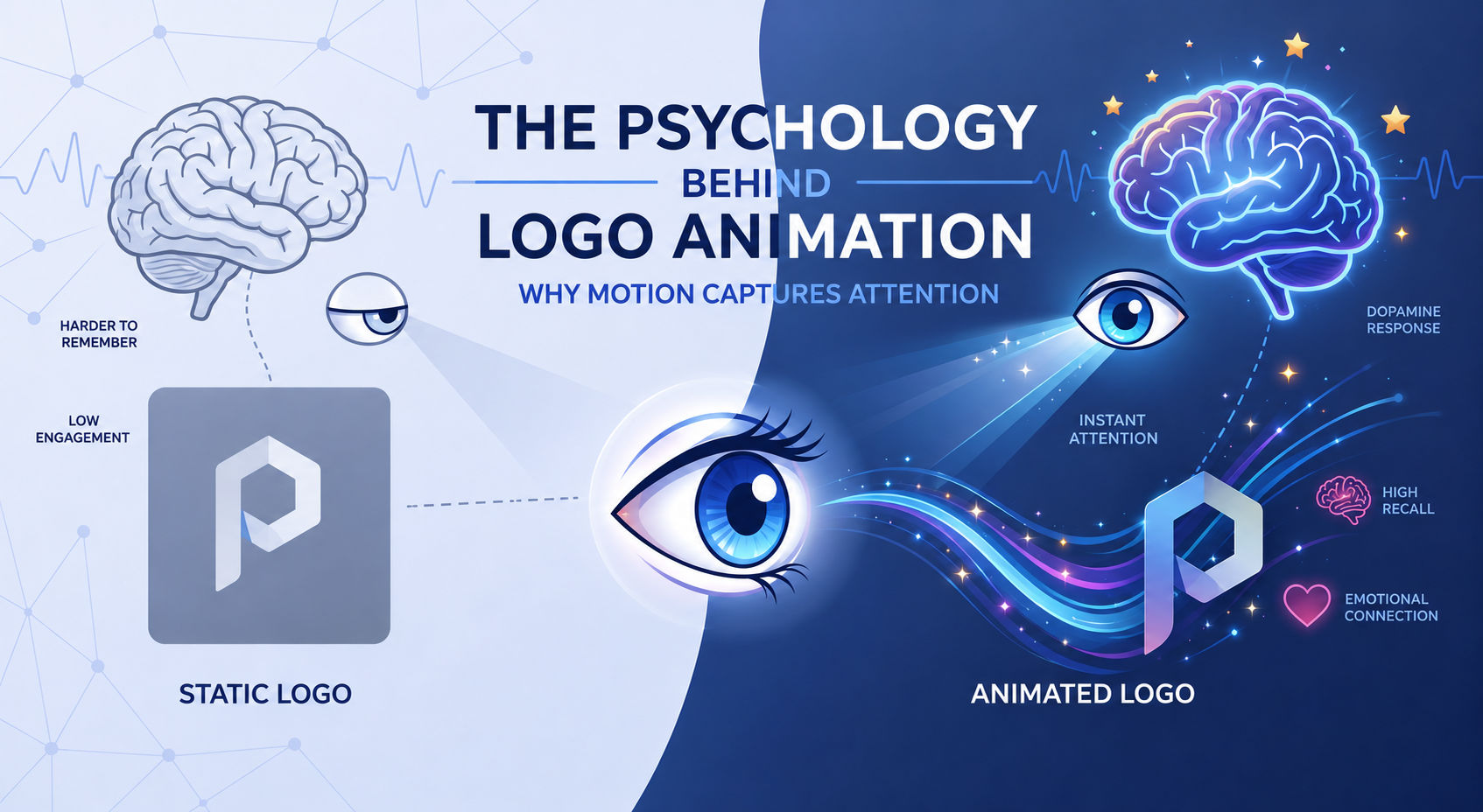
The Psychology Behind Logo Animation: Why Motion Captures Attention
Before you read a single word on a webpage, something else has already happened. Your eyes moved. They followed something. That something was probably moving.
This isn't a coincidence or a clever design trick; it's biology. The human brain is wired to detect motion before it processes language, color, or even shape. And that one fact is the foundation behind everything that makes logo animation so effective as a branding tool.
In this article, you'll learn exactly why animated logos work at a psychological level, what happens in the brain when someone sees a moving brand mark, how motion design builds trust and memory, and what this means for your own brand decisions. No design jargon, no fluff, just a clear explanation of why motion does what static simply can't.
Why the Brain Responds to Motion Differently Than to Still Images
To understand motion design psychology, you need to start with how human vision actually works, and it's not the way most people assume.
The eye doesn't see everything in the visual field equally. The central area of focus (called the fovea) processes detail sharply, but peripheral vision, the blurry edges of what you see, is highly sensitive to movement. This is an evolutionary survival mechanism. For early humans, movement in the periphery meant a predator, a threat, or something worth immediate attention. That instinct hasn't gone anywhere. It just now applies to smartphone screens and website headers.
When something moves in your visual field, your brain automatically redirects attention to it, before conscious thought kicks in. This is called an orienting response, and it happens in milliseconds. It's involuntary. You can't decide to notice motion; your nervous system decides for you.
For brands, this is significant. A static logo competes with everything else on the page for attention. An animated logo triggers the orienting response and wins that competition before the viewer even knows there's a contest.
What Motion Design Psychology Tells Us About Memory
Grabbing attention is one thing. Holding it, and being remembered, is another. This is where motion design psychology does its second job.
Movement Creates Emotional Encoding
Research in cognitive psychology consistently shows that emotional experiences are remembered more vividly and for longer than neutral ones. Movement, particularly movement that feels satisfying or surprising, generates a mild emotional response: curiosity, delight, a sense of something clicking into place. That emotional charge acts as a memory anchor, attaching the brand to a feeling rather than just a visual.
A logo that "does something" interesting when it loads, bounces into frame, or morphs between shapes creates a micro-moment of engagement. That moment is small, but it's enough to shift the experience from passive viewing to active noticing, and active noticing is what leads to recall.
The Mere Exposure Effect and Animated Logos
Psychologists have long documented what's known as the mere exposure effect: people develop a preference for things they've seen more frequently, even without consciously remembering those exposures. An animated logo that plays briefly on a loading screen, a social media post, or a video intro keeps accumulating these micro-exposures in a way a static logo can't.
Every time someone sees the animation play, even for two seconds, familiarity quietly deepens. Over time, that familiarity converts into preference, and preference converts into trust.
How Logo Animation Builds Brand Trust
Trust is one of the harder things to build quickly in marketing, and it's also one of the most valuable. This is where logo animation engagement intersects with brand psychology in a particularly practical way.
Polish Signals Professionalism
When a logo animates smoothly and intentionally, when the motion feels considered rather than random, it communicates something about the business behind it. A brand that has invested in a well-crafted animation is implicitly communicating that it pays attention to detail, that it cares about presentation, and that it's established enough to invest in quality.
This happens subconsciously and quickly. Visitors don't think "this logo animation signals professionalism." They simply feel a slightly higher level of confidence in the brand, without being able to articulate why.
Consistency Across Motion Builds Recognition
One of the most powerful things a brand can do is be instantly recognizable across different contexts: a website, a video intro, a social media profile, a presentation. A static logo achieves this through consistent shape and color. An animated logo adds a third layer: a consistent movement signature.
Just as a person's walk can be recognized from a distance before their face is visible, a brand's animation style can become recognizable before the logo itself resolves clearly. This kind of multi-sensory recognition is harder to build with static design alone, and it's part of why animated logos work so well for brands investing in long-term recognition.
(Internal link opportunity: connect to a Logo & Brand Identity article here, since animation works as an extension of a broader identity system.)
The Role of Timing and Easing in Motion Psychology
Not all animation is psychologically equal. The specific way a logo moves- how fast, how smoothly, whether it eases in or snaps into place- produces different emotional responses.
Slow, Smooth Motion Feels Premium
Animations with gentle easing (where motion starts slowly, accelerates slightly, then slows again before stopping) tend to read as sophisticated and calm. Luxury brands, financial services, and high-end creative agencies often favor this kind of motion because it matches the emotional tone they want to project.
Fast, Snappy Motion Feels Energetic
Quick, precise animations with minimal easing feel confident and direct. Tech companies, startups, and consumer apps often use this style because it suggests speed, efficiency, and energy, all qualities their audiences value.
Unexpected Motion Creates Delight
Logos that do something slightly surprising, a character that blinks, a shape that morphs unexpectedly into another, trigger a small burst of dopamine associated with novelty. This delight response is brief but memorable, and it's one of the reasons playful brand animations tend to travel well on social media.
The takeaway here is that motion style isn't just aesthetic preference. It's a psychological decision that shapes how a brand feels, and brands that choose their animation style intentionally are making a statement about their values, not just their visual identity.
Logo Animation Engagement Across Different Platforms
Understanding the psychology is one thing. Applying it across the places a brand actually lives is another.
Website and Landing Pages
On a website, a logo animation that plays once on load creates a brief but impactful first impression. It signals that the brand is active and current, sets an emotional tone before any copy is read, and gives the visitor a fraction of a second more engagement with the brand before they move on to the content.
Video Content and Social Media
In video intros and social media content, a consistent logo animation acts as a brand signature , the equivalent of a TV show's title sequence. Viewers who see the same animation repeatedly begin to associate it with the content they enjoy, building brand loyalty through the mere exposure effect described earlier.
Presentations and Pitch Decks
For B2B brands and startups, a logo animation in a pitch deck or investor presentation adds a layer of polish that static logos can't match. In a room full of competing brands, small differentiators matter, and a confident, well-crafted animation is one of the quieter but more effective ones.
Frequently Asked Questions
Why do animated logos grab attention faster than static ones? Because the human brain is biologically wired to detect motion before processing still images. When a logo animates, it triggers an involuntary orienting response, the same instinct that makes movement in your peripheral vision impossible to ignore, which redirects attention to the brand before conscious thought kicks in.
Does logo animation actually improve brand recall? Yes, through two psychological mechanisms: emotional encoding (movement creates a mild emotional response that makes the brand more memorable) and the mere exposure effect (repeated micro-exposures to the animation build familiarity and preference over time).
Does every business need an animated logo? Not necessarily as an immediate priority, but any brand that uses video content, maintains an active social media presence, or wants to build stronger recognition over time will typically benefit from one. The investment tends to compound; each exposure adds to familiarity without requiring additional budget.
Can the wrong kind of animation hurt a brand? Yes. Motion that feels mismatched to the brand's personality, a rushed, jittery animation for a premium brand, or a stiff corporate motion for a playful consumer brand can create a subtle disconnect that undermines trust rather than building it. Animation style should be chosen with the same intentionality as color or typography.
How long should a logo animation be? Most effective logo animations run between one and three seconds, long enough to complete a satisfying motion, short enough to fit naturally into video intros, website loads, and social media content without feeling drawn out.
Final Thoughts: Motion Is a Branding Decision, Not Just a Design One
The psychology behind logo animation isn't complicated once it's laid out clearly. Motion captures attention because our brains evolved to notice it. It builds memory because movement generates emotional engagement. It builds trust because polish signals professionalism. And it compounds over time because every viewing, however brief, deepens familiarity.
None of this means a static logo is wrong or outdated. It means that brands choosing to animate their logo are making a decision about how they want to be experienced, not just seen. And that decision, made thoughtfully and executed well, tends to pay off in ways that are hard to measure precisely but very easy to notice.
Curious what the right animation style looks like for your brand's personality? Get in touch with Pixamo Studio, and let's figure out what kind of motion fits your brand best and turn your logo into something people actually remember seeing.